Hal Moore on Leadership by Harold G. Moore
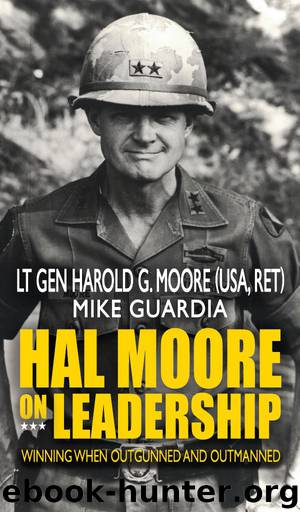
Author:Harold G. Moore [Guardia, Mike]
Language: eng
Format: epub
Tags: Self-Help, Business, Military
Publisher: Magnum Books
Published: 2017-07-01T04:00:00+00:00
Upon concluding his tour at the Academy, Moore attended the US Army Command and General Staff College (CGCS) at Fort Leavenworth, Kansas for a yearlong course of study. Renowned as one of the toughest schools in the Army, CGSC prepared young Majors for the organizational dynamics of Division and Corps-level staff. Moore then reported to Air Mobility Division in the Office of the Chief of Research and Development at the Pentagon.
“At Fort Bragg, I jump-tested experimental parachutes and other equipment developed for Army paratroopers from various Air Force and Army aircraft. Now, in the Pentagon my responsibility was to monitor the development of that equipment for the Army and work with the Air Force to make sure that Army requirements for hauling and dropping troops and equipment were met in the development of new Troop Carrier airplanes. I made frequent trips to civilian firms and the Army and Air Force agencies charged with the actual hardware development to check up on progress. During many of those visits, I would jump different equipment from various aircraft. I was the only Army officer in the Pentagon on ‘jump pay’—an extra $100 a month.
“Those years, 1957-1960, also saw the development of the Army’s concept for Air Assault and Airmobile tactics. My boss [Lieutenant General James A. Gavin] oversaw all that as well. I was a Major by then and served under three successive full colonels with extensive ground combat experience in World War II: Colonels Jack Norton, Phil Seneff, and Bob Williams. All were very sharp, imaginative officers, and held in high regard by the top generals in the Army and obviously destined for higher rank. All three, in fact, advanced to three-star general. Their time was primarily devoted to fighting for funds to develop the family of Army helicopters and to get the Airmobile/Air Assault concept ‘off the ground.’ They trusted me completely, told me what they wanted from me; gave me guidance, and let me ‘run with the ball.’ After my trips to the field, I would write up a ‘Trip Report’ for them and for my project files, which they could read when fitted into their schedule. These men were fast movers, and I had to move fast, think fast, and turn in good work to keep ahead of the power curve. Workweeks were long: 50-60 hours, Monday—Saturday and I took unclassified papers home with me for night work when my wife and children were in bed.”
At the Pentagon, he said, “the pressure and stress level were very high due to the volume of work, long hours, and tight deadlines for decisions involving a lot of money and vast numbers of people. To help control that stress and stay in shape for field duty, every day during lunch hour I either went to the Pentagon Athletic Club and got a workout playing handball or, on alternate days, ran the two miles over to the Lincoln Memorial and back. I’m a firm believer that physical fitness aids mental fitness. My wife
Download
This site does not store any files on its server. We only index and link to content provided by other sites. Please contact the content providers to delete copyright contents if any and email us, we'll remove relevant links or contents immediately.
Hit Refresh by Satya Nadella(9126)
The Compound Effect by Darren Hardy(8949)
Change Your Questions, Change Your Life by Marilee Adams(7761)
Nudge - Improving Decisions about Health, Wealth, and Happiness by Thaler Sunstein(7694)
The Black Swan by Nassim Nicholas Taleb(7111)
Deep Work by Cal Newport(7068)
Rich Dad Poor Dad by Robert T. Kiyosaki(6613)
Daring Greatly by Brene Brown(6504)
Principles: Life and Work by Ray Dalio(6422)
Playing to Win_ How Strategy Really Works by A.G. Lafley & Roger L. Martin(6252)
Man-made Catastrophes and Risk Information Concealment by Dmitry Chernov & Didier Sornette(6007)
Big Magic: Creative Living Beyond Fear by Elizabeth Gilbert(5756)
Digital Minimalism by Cal Newport;(5750)
The Myth of the Strong Leader by Archie Brown(5500)
The Slight Edge by Jeff Olson(5410)
Discipline Equals Freedom by Jocko Willink(5379)
The Motivation Myth by Jeff Haden(5206)
The Laws of Human Nature by Robert Greene(5179)
Stone's Rules by Roger Stone(5081)
